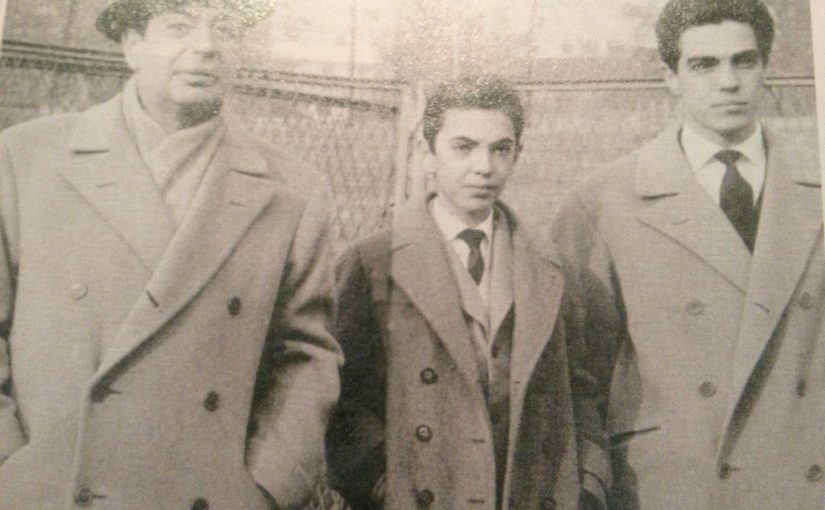
Massimo Moratti with his father & one of his older brothers
He is left-footed. He loves old Humphrey Bogart movies. He chainsmokes. He loves Inter. His odyssey is over.
In 1993 a journalist at Gazzetta dello Sport whose main job was to cover Inter for the newspaper, sent Massimo Moratti an envelope.
The envelope consisted of a handwritten note as well as a few 1000-lire notes. On the note he’d written: “Here’s a small contribution if you should decide to buy the club. A couple of days later the journalist received an envelope from Massimo Moratti.
Inside the envelope the journalist found a gold coin and a sheet of paper where Massimo Moratti had written by hand: “As you can see, giving money to a Moratti is always a solid investment.”
Somewhere around that time a spark had been ignited. Giving gold coins was a tradition that his father, Angelo, had started in which he gifted a gold coin to players who had excelled on the pitch
Two years later, in 1995, Massimo Moratti bought the club which lay closest to his heart. After four weeks the check was signed and the final price was around €35 million.
A bottle of Dom Perignon was opened. Massimo was 50 years old when making the purchase which would cause him so much joy as well as suffering.
Spending big and spending immediately was what distinguished Massimo Moratti. Every summer that passed players were bought and sold. The players signed were usually foreign players who commanded the highest wages in Serie A.
During a period Moratti and Inter had 69 players under contract, as the club had already broken the world record for transfer fees when first signing Ronaldo from Barcelona and a few years later Christian Vieri from Lazio.
Moratti needed to kick-start Inter and their fans, he needed the love from the people of Milan. The player he needed was Ronaldo.
He was the player who put Inter on the map after several difficult years. Another player who made the headlines back then was Uruguayan player Alvaro Recoba who was the highest paid footballer in the world then and there. He was paid roughly €7 million/season.
Problems later surfaced when it turned out that he had a fake passport, missed too many matches due to injuries but above all was far too inconsistent.
Massimo Moratti differs greatly from your average European super-club President. He is an open person, who spoke to reporters on a daily basis outside of Saras offices in central Milano who were stood outside waiting for a statement from the Inter supremo.
He walks his dog every night outside of his home and enjoys speaking to people who he happens to stumble upon. For those who saw Inter during their pre-season training camp in Varberg, Sweden, it wasn’t an unusual site to see Massimo ride his bicycle on the streets of the small Swedish town to and from the local stadium.
Inside Massimo Moratti’s home you can find a full size cut-out of Humphrey Bogart holding a giant Inter-flag, an ‘I Love Inter’ sticker in the kitchen and in a corner a foosball game, found in any bar.
Massimo is more of a fan than a President. Or was. It’s a new day and age now. Massimo made the same journey his father did.
And just like his father he arrived at a point where the time was right to bid his love farewell, in this case the football club FC Internazionale Milano.
It will feel very strange to see an Inter without Moratti and his family being zoomed in by the TV-cameras whilst nervously puffing away on a cigarette in the 85th minute with the score being 1-1 against Chievo at the San Siro.
Massimo Moratti. Left winger. Left-footed. Rich. Father-figure. Rolling Stones-fan. But above all, a passionate Inter-supporter.
Grazie per tutto.
Thank you for everything.
Daniel Hamilton


i should say this piece about moratti is brilliant. i’ve red some writtings about moratti but so far this is the best..well done mate