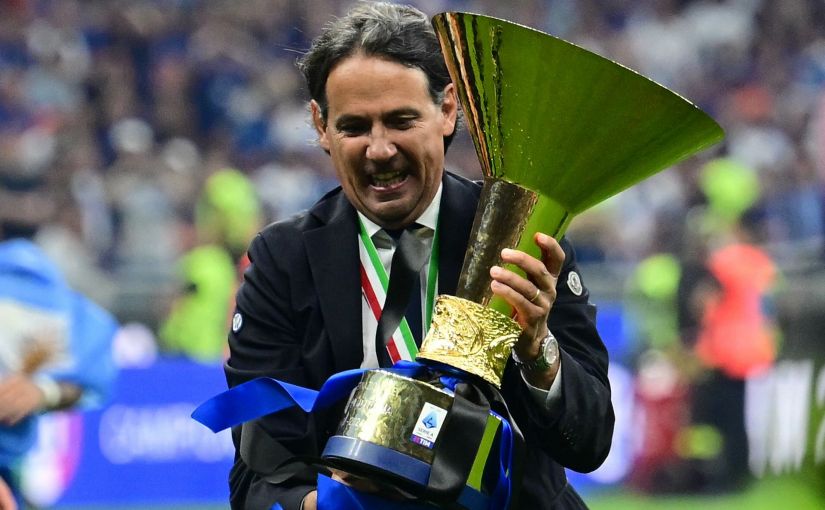
Football tactics often go in a cycle where an innovative new setup becomes all the rage because one forward-thinking manager has implemented it, and then managers of other clubs follow suit and try to adapt some of the elements into their tactics.
Great managers like Carlo Ancelotti and Pep Guardiola are obvious pioneers of formations that have led them to glory down the years. But there have also been significant periods where formations have played a key part in keeping Inter Milan on top.
While bettors put a lot of stock into things like current form and head-to-head records, often overlooked is the importance of formations. For example, a more attacking formation could lead to higher-scoring matches. So, how a team sets up tactically can directly impact your stakes as well as a way to play betting games offered by bookmakers for free where you often need to make predictions on sports events to win rewards. So the formation is important to take into account especially if you are trying to predict something like the number of goals.
Here’s a look at some of the most effective formations that Inter have used.
Simone Inzaghi 3-5-2
Simone Inzaghi has been using the 3-5-2 formation since the start of his managerial career. Fitting well with the old-school philosophy of Italian football, there is a great defensive solidity that comes with the 3-5-2.
It’s the trio across the heart of the defence that bolsters the effectiveness of this formation, which is particularly strong against teams that play more narrow in attack. The 3-5-2 includes wing-backs that have the dual role of dropping back to help out in defence and pushing up the field to create attacking options on the flanks.
Three central midfield players provide a solid core and break up the game in the middle of the park. Inzaghi has benefited from core players like Hakan Çalhanoğlu tirelessly working the midfield, and it often forces attacking teams to try and play wide, cutting out some threat.
Inter’s quick counter-attacking benefitted from Lautaro Martinez’s pace and clinical finishing, during their 2023/24 Scudetto, with Marcus Thuram taking over the role to a bigger effect the following season.
Antonio Conte’s 3-1-4-2
Another great Inter manager who relied on three men in defence was Antonio Conte. When he arrived at the club, he quickly transformed their fortunes, with a 3-1-4-2 formation that had defenders Stefan De Vrij and Milan Skriniar at the core.
Conte employed a permanent holding midfielder, Marcelo Brozovic, who would line up with more creative midfielders Stefano Sensi and Nicolo Barella.
Brozovic was the kingpin because he could dictate the pace and flow of a game, dropping deep to get the ball from the defence. From that position, Brozovic’s presence allowed those in the number 8 and 10 positions to push forward.
Antonio Conte also worked Inter hard to install a high press, starting with his two strikers. They, along with the attacking midfielders, would really get a squeeze on the opposition defence and the work he demanded of his team was seen in his industrious wing backs.
Up front, this system managed to see Romelu Lukaku reignite his faltering career. Playing alongside Lautaro Martinez allowed Lukaku to just focus on his physical and aerial threats, and leave the fancy stuff to his strike partner. They complement each other very well.
Giovanni Trapattoni’s 4-3-3
Legendary manager Giovanni Trapattoni preferred the 4-3-3 during his time in charge. He was a little more flexible in this shape than most managers were because he would allow his full-backs to get a little further forward.
He’d release one at a time while having the other slot in a defensive three while in possession, which led to Trapattoni’s great success with Inter in the 1988/89 season.
In the middle of the park, Trapattoni’s 4-3-3 had a fairly narrow triangle, with the fulcrum being a deep-lying playmaker. They would complement a box-to-box midfielder and a Mezzala that would pull away into the spaces to set up attacking options.
Jose Mourinho’s 4-2-3-1
The Special One arrived at Inter in 2008, and in the 2009/10 season, Jose Mourinho won the treble of the Serie A, Coppa Italia, and the Champions League.
He was blessed with some great talent, and while Mourinho predominantly played 4-2-3-1, he would also switch to 4-3-1-2 at times.
The two-man midfield was something different, and typically a balance of a box-to-box midfielder in Dejan Stankovic who could work both ends of the pitch and a Carrilero in Esteban Cambiasso who would cover the middle of the park horizontally.
The attack was led by an attacking midfielder, who was typically Wesley Sneijder who played being the main striker Diego Milito.
Two wide players would then create different attacks, Goran Pandev tending to stay wide, while Samuel Eto’o would be more of an inside forward.



Live Comments
Welcome to our Live Comments section, where new comments will appear automatically
Add a Comment